
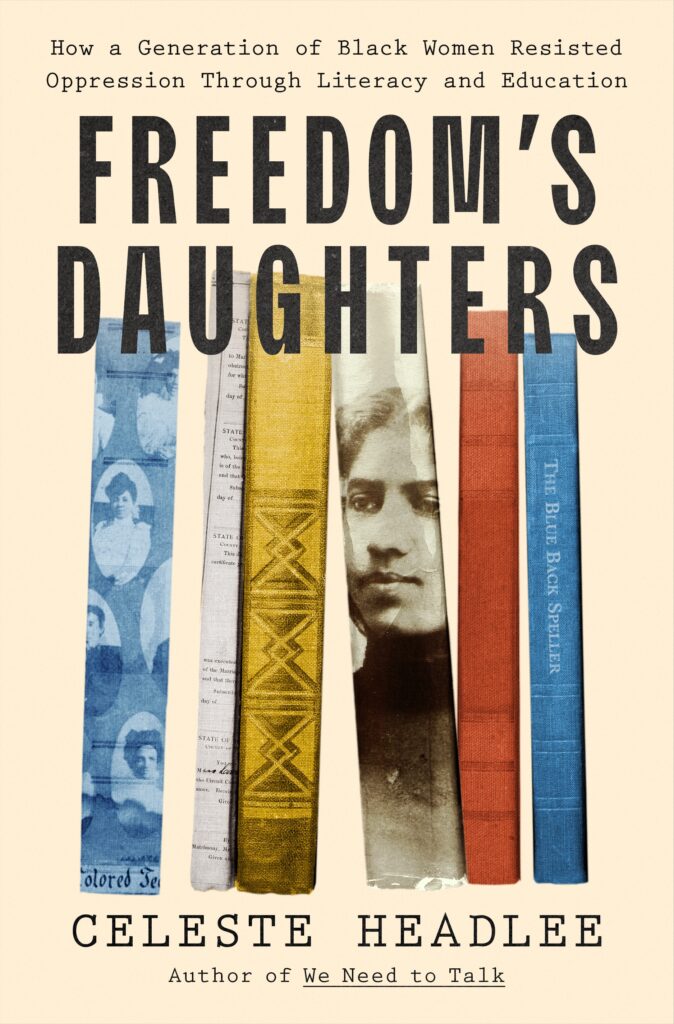
In FREEDOM’S DAUGHTERS: How a Generation of Black Women Resisted Oppression Through Literacy and Education, Celeste Headlee writes an urgent and eye-opening story of the women who risked everything to ensure a generation of Black Americans had the right to read. In her letter to librarians, she shares her personal connection to the story, and the importance of access to literacy and education.
Dear Librarian,
It’s so nice to communicate directly with the people who helped inspire my book, FREEDOM’S DAUGHTERS, and to whom the book is dedicated. The book begins with an expression of gratitude to all members of your profession, who “preserve history, knowledge, and human dignity . . . the keepers of our memories and the guardians of our shared human story.”
I’ve always known that my great-grandmother opened the first library for African Americans in the state of Arkansas, so when I set out to tell her story, I began to research the history of Black librarians. Imagine my surprise when I discovered the stories of so many fearless women who had risked life and limb to get books into the hands of children in the South. I decided to tell not only the story of my great-grandmother but the story of the many heroines who made education and literacy their vehicle for liberation and empowerment.
In a way, this book is a personal story about my pursuit of the truth about my family history and my yearning to know more about the woman who had profoundly influenced my upbringing. I’ve made Carrie Still Shepperson’s biography as engaging as possible, with vivid descriptions of daily life in the late 19th century and of her work with the NAACP and other organizations.
However, this book is also an acknowledgement of the debt we all owe to Carrie’s generation, the daughters of freedom who came of age in the ashes of the Confederacy. They worked so hard to make life better for the next generation, sacrificed and labored to make knowledge accessible, and were then forgotten by history. Their removal from the narrative has given Americans today an inaccurate view of the nation and why we are still fighting over citizenship, education, and identity.
Much of this story resonates with what is happening in the US today – the battle over history and whose stories are told, the fight over what is taught in classrooms and who gets to teach it, and the resistance against any erosion of our civil rights. Carrie even lived through a pandemic, as we have, surviving the Spanish Flu in the second decade of the 20th century.
For lovers of classical music, the book will give an intimate portrait of the childhood and early development of one of the nation’s most celebrated musicians—William Grant Still, known as the Dean of African American Composers.
Mostly, though, this book is meant to remind us how crucial the access to knowledge is for a functioning democracy. I hope, when readers finish the book, that they will both realize the great importance of libraries and understand that a people cannot be truly free unless they can read whatever books they choose. So, here’s to the librarians who stand on the frontlines of battle for liberty: this book is for you.
With gratitude,
Celeste
Author of FREEDOM’S DAUGHTERS: How a Generation of Black Women Resisted Oppression Through Literacy and Education
 The owner of this website has made a commitment to accessibility and inclusion, please report any problems that you encounter using the contact form on this website. This site uses the WP ADA Compliance Check plugin to enhance accessibility.