

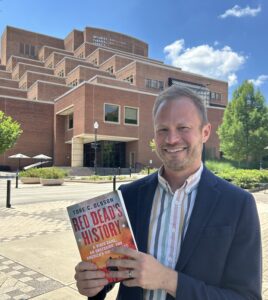
Tore Olsson’s RED DEAD’S HISTORY: A Video Game, an Obsession, and America’s Violent Past is a pathbreaking new way to examine US history, through the lens of a bestselling video game.
In Olsson’s letter, we learn that his local library provided an intellectual link to a world halted by a global pandemic. Within its walls, this historian—without his usual archive—was inspired by the shelves to create his latest work: a fascinating analysis of American violence, race, and capitalism, articulated via the viral video game Red Dead Redemption. The library, an essential space during the pandemic, became a lifeline.
RED DEAD’S HISTORY: A Video Game, an Obsession, and America’s Violent Past is available to download on Edelweiss and NetGalley.
For nearly two years, the Covid-19 pandemic shuttered non-essential workplaces, separating countless millions from the places where they make a living. Chefs ached for their diners, musicians for their cheering fans, and hoteliers from their guests. And though it made fewer headlines, historians longed for their archives – the essential repositories from which we craft original interpretations of the past. Shut out from our places of research, many of us in the profession wondered: how does one write history in a pandemic?
This crisis weighed heavily upon me. My grand plans for summer 2020 research in Nigeria and the Philippines were tragically dashed; my book project on the global history of American country music was indefinitely on hold. Instead, I was left stranded in a place far too familiar: Knoxville, Tennessee, where I live and work. On the nearly-abandoned campus of the University of Tennessee, with no access to the traditional lifeblood of my craft, it was hard not to succumb to gloomy boredom.
But after those first anxious months, a lifeline appeared – Hodges Library, the central hub of the university, reopened to the public with reduced hours and social distancing measures. Hodges is an unusually memorable building; built in the style of a terraced Mesopotamian ziggurat, its labyrinthine halls hold millions of volumes. Within, I found an island of calm in a turbulent sea. It was not long before my visits to Hodges became increasingly regular, a sort of pilgrimage – the library came to represent my intellectual link to the world beyond.
It was in the stacks that I found an outlet for my professional frustrations. With archives closed indefinitely, I wondered: why not write a book based on the crowded shelves that surround me? It’s not uncommon for historians to write works of “synthesis” that digest and harmonize narrower studies, making them accessible and relevant to new audiences. Yet such books, built from published work, require a unique angle – something to make the book greater than the sum of its parts.
Unexpectedly, the pandemic brought me precisely that angle. In the same months that I was making my pilgrimages to the library, I was also returning to a high-school hobby that had once dominated my life – playing video games. Amid the pandemic’s lockdowns, I picked up a controller after a twenty-year hiatus. And one of the first titles that I played was Red Dead Redemption II, a 2018 game set in a fictionalized America of 1899. The game was a colossal blockbuster; it has now sold more than sixty million copies. And as I was rather surprised to learn, the game frequently alludes to major social, political, and economic dilemmas that American historians have spent generations studying. In the game, players participate in a women’s suffrage protest, learn about the burgeoning power of new industrial corporations, and confront the racial inequalities of the West and South.
I first began playing the game for fun, but it wasn’t long before the historian in me got excited about the possibility of using this piece of pop culture to introduce new audiences to the real-life drama of the American past. And so was born RED DEAD’S HISTORY – a book that uses the fictional content of the Red Dead Redemption games to explore what really fueled American violence in the half-century after the Civil War. As such, it’s profoundly a book about race and capitalism.
This was the perfect pandemic project – it required not archives and travel, but a video game console and a good research library. And thus I waited out Covid-19 in the stacks of Hodges, feverishly pulling books on railroads, lynching, cowboys, mining, and countless other topics raised in the video games. This was a true work of historical synthesis – yet in a shape that few might have expected.
When the book debuts in August, I imagine many will interpret it as a historian’s love letter to digital games. In part it is that, but it’s just as much my love letter to a beautiful library that remained open during the dark months of the pandemic. Without it, the book could never have come into being.
RED DEAD’S HISTORY: A Video Game, an Obsession, and America’s Violent Past by Tore Olsson; 9781250287700; 8/6/24
 The owner of this website has made a commitment to accessibility and inclusion, please report any problems that you encounter using the contact form on this website. This site uses the WP ADA Compliance Check plugin to enhance accessibility.